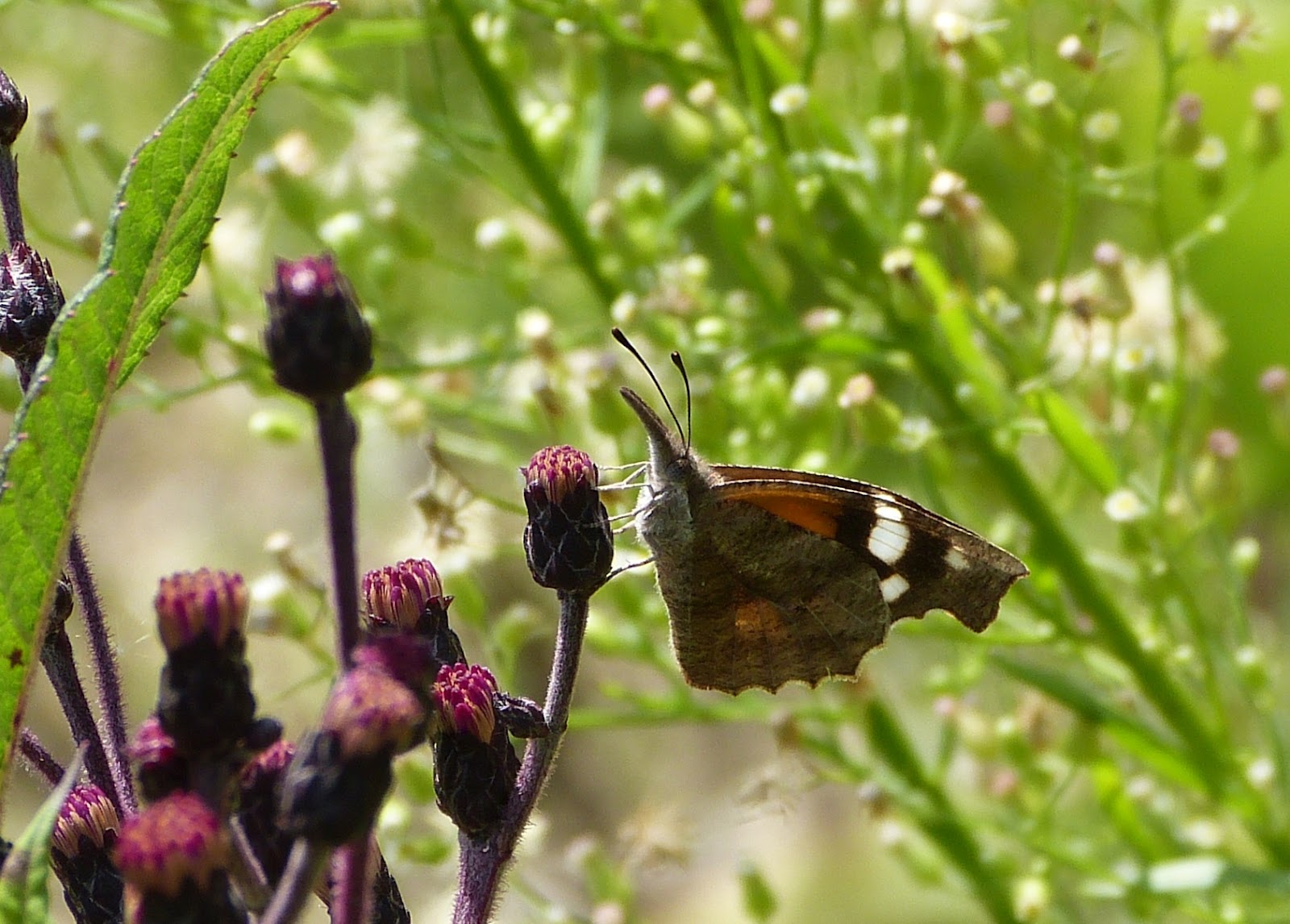
Thursday, 27 September 2012

Lesser Black-backed Gull - Port Stanley

I'm guessing if anyone is following this blog they likely follow Brandon Holden's blog as well and are aware of the "50 Days of Rare competition". In a nutshell, a bunch of birders are seeing who can find the "rarest" bird over the next 6-7 weeks. So far the best I have been able to do is a Lesser Black-backed Gull that I found today at Port Stanley today. It seems like everyone is finding these guys this year.

Lesser Black-backed Gull

At Port Burwell there were hundreds of gulls but nothing rare amongst them that I could see. Six Sanderling were a nice consolation prize on the west beach along with three Black-bellied Plovers.

Sanderling
 

Yesterday at Turkey Point I checked the beach and was surprised at the large amount of shorebird habitat along the beach. The low water levels are a bonus for shorebirding this fall. I spied a single American-golden Plover amongst the more numerous Black-bellieds, and there were several Baird's Sandpipers mixed in with the more regular peeps.

 Turkey Point beach

 Baird's Sandpipers
 
Black-bellied Plover on the left, American Golden-Plover on the right.
 
 At first I thought I "found" the AGPL but after checking ebird I realized one (perhaps this one) was first seen on September 22nd by several observers. If we pretend this was a mega-rarity and I was hoping to win the 50 days of rare competition with this bird, I may not be able to count it as a "self-found" bird. The rules are strict and the issue of "news ignorance" and "re-finds" is dealt with. See http://punkbirder.webs.com/selffoundrules.htm for all the rules


Tuesday, 25 September 2012

Ruffed Grouse beside road

Title says it all... I haven't posted much in September - I'll try and do better!


Sunday, 16 September 2012

Tip of Long Point

I had the opportunity last week (Wednesday) to go to the Tip of Long Point for the day - my first time in many years! Birds were slow, and I didn't find any rare migrant b-flies or d-flies but it was still an interesting trip. I had wishes of a Frigatebird or Brown Pelican on the boat rides to and from the point but neither materialized. Bird highlight was a Hudsonian Godwit we found on a sandbar with gulls and other shorebirds. A Laughing Gull turned up at the tip - but not until we had already left and were back at the mainland! That's the way it goes sometimes...

We came across this dead Softshell Turtle up on one of the dunes next to the shoreline. Apparently it had been there since June and was basically mummified and not scavenged at all. We also found 1 or 2 predated softshell nests.
 
  Melanistic Gartersnakes are super common at Long Point.
 
 Dragonflies were flying in huge numbers and Monarchs were starting to amass on this willow.
 
 Phragmites are a real problem on the point...

 The Tip! It often has rarities galore and large numbers of gulls loaf there. Sitting on the sand not too far from the gulls were 2 Peregrine Falcons (below). Don't think I've even seen them sitting on the ground before.

 This was a new Tiger Beetle for me (Cicindela hirticollis). They are a shoreline species but I'm not too sure how common or rare they are. I'm guessing Pelee has them.
 O.K. these were not from the Tip, but rather from St. Williams earlier in the week. I was happy to find Dainty Sulphurs in several places, including at my place. 

Tuesday, 28 August 2012

Hog-nosed Snakes hatch; random stuff

On August 28th I checked on a location where I knew Hog-nosed Snakes had nested and was surprised to see some animal diggings and some eggshells on the surface. I was disheartened at first because I thought they had been predated but when I showed them to my friend Jon he explained that the snakes had already hatched. The snakes hatched, shed their skin, and hopefully slithered away safely. A predator like a skunk or raccoon came along, sniffed out the nest, and dug up the already hatched eggs. The eggs were deflated, didn't show any bite marks, and there were shed skins around the nesting site. We found two nests, one with 26 eggs, and the other with 8. The 26 eggs may have been laid by one big mama, or perhaps several females using the same site.
Generally open sandy habitat with diggings and a few scattered egg shells.
 
We further dug up the nest to count the already hatched eggs.
 Hard to see, but there are some small snake skins in this photo.

Other random photos and ramblings:

 This robber fly was flying around with this Cabbage White and it kind of startled me. It looked like a big cotton ball was just whizzing around and I had no idea what I was looking at.
 
 Saw these guys while paddling around Long Point Bay. Northern Map Turtle above and a Blanding's Turtle below.

 Recent Eared Grebe and Short-billed Dowitchers at Townsend

Tuesday, 21 August 2012

Norfolk Sachems and Dainty Sulphers

After reading about all the cool southern butterflies people were seeing recently in other parts of Ontario I was chomping at the bit to go look for some in Norfolk. On August 12th a colony of Dainty Sulphurs were discovered just down the road from my house and I finally made an effort to find them on August 18th.  Without too much effort I was able to find 2 individuals. This colony is quite disjunct from the other colonies being observed in the "greater Pelee area".
One of 2 Dainty Sulphurs I observed.

Fiery Skippers and Sachems have been recorded all over the place so it comes as no surprise that they too have made their way to Norfolk. Fierys often wander into the province but the Sachem invasion was quite unexpected (unprecedented?). On some private property near St.Williams I was able to see a few each of both Fiery Skipper and my main target - the Sachem. Despite checking many other seemingly suitable places I haven't found good numbers of them at any other location.


 A couple shots of a Sachem (above). Fierys (below). 

At this same location I also found a few Peck's Skippers, a skipper I don't easily find in Norfolk for some reason. A snout was another unexpected treat.


 Peck's Skipper above, Snout below.


And finally, Grey Hairstreak. These guys too invade in late summer and I was able to find one at my place near Walsingham. They seem to be really abundant at Pelee right now, but I haven't found many around here. Fingers crossed for a White-M Hairstreak to show up...


Monday, 13 August 2012

Dragonflies in the News


If you think birdwatching is a bit on the fringe of what makes the news, then news on dragonflies and other insects is even more rare. Recently the Long Point Basin Land Trust put out a news release detailing the story of how my colleague photographed Purple Martins eating dragonflies, and one of these dragonflies turned out to be a Comet Darner. The story got picked up by many newspapers and even got me an interview on CBC radio! Just goes to show you that there's an appetite for this sort of nature nugget. Just to refresh your memory, one of the photos is below (photo credit Gregor Beck). 


The news release emphasized the novel method of studying dragonflies by watching what the martins brought in, and a lesser extent that the Comet darner is rather uncommon. Well the story ended up getting picked up by a number of newspapers in Southern Ontario, and many tried to put their own slant on things. Many  wanted to emphasize the rarity of the Comet Darner - you would have thought I discovered the first one in Ontario or something, while others even tried to make connections to Global Warming. People wanted to know - what does all this mean? Is it bad that the martins are eating "rare" dragonflies? The short answer was it's not bad or good - it's just cool! We just thought it was a fun story.

Also it's funny how easily it is to get miss-quoted, or have things taken out of context. I was quoted as saying "...the unusually warm spring and summer in the area that has also attracted new species of butterflies to Norfolk, including the rare Red Admiral..." I most certainly did not call Red Admirals rare, and I think the news reporter just mixed a few quotes together by accident. Next time I read some bizarre "quote" in the newspaper I'll keep in mind that it might not be exactly what was said.

Here are a couple newspaper articles that took different slants on the topic.

July19th - The Record - Kitchener Waterloo
http://www.therecord.com/living/article/764202--rare-dragonfly-spotted-in-ontario

July19th - Simcoe Reformer
http://www.simcoereformer.ca/2012/07/19/dragonflies-cross-lake-erie

Shortly after these news releases, someone from CBC radio Calgary called to chat with me a little more about Dragonflies. He was already doing a story on dragonflies, and must have stumbled across my name after reading one of the newspaper articles. Anyways, we had a nice little interview over the phone and he ended up using some of it in a nice little piece on dragonflies. Kind of funny to hear my "radio voice". I had hoped to post the audio file on here, but it seems like adding audio to this blog is a bit of pain in the but so you are going to have to take my word for it!




Friday, 27 July 2012

Fresh-water Jellyfish - Port Dover

No this is not a hoax - and for some of you it might be old news, but I personally had no idea that there are fresh-water jellyfish (Craspedacusta sowerbii)occurring in Ontario. I was not so surprised to learn that they are an invasive species that found it's way from Asia to North America some 100 years ago. My interest in these guys came about a few weeks ago when I got a phone call from a friend in Port Dover. He had a video of a jellyfish that his friend  had found in Black Creek in Port Dover. Anyways, the video is pretty grainy but it clearly shows a small jellyfish just blobbing along like they do. From what I've been able to glean from the internet it seems like they prefer warm, still-moving water, are pretty small and aren't dangerous to people.  They probably have a negative impact on the environment but I guess it can't be too bad (relatively speaking) since they haven't got the sort of press zebra mussels and other invasives have gotten.