A bit of a tradition for many birders is to work off their hangovers by going out birding on January 1st -kicking of a fresh year of birding and listing. I'm not a rabid lister like so many others and have never kept a "year list", but there's something symbolic about getting out on Jan one.
This year I have two New Year's resolutions related to birding. Firstly, enter at least one e-bird checklist into e-bird every single day of the year. This takes a bit of discipline but otherwise shouldn't be too hard. A checklist can be made just by looking out the window at the bird feeder, or recording what I see while driving to work. The trick will be to do it everyday, and will hopefully make me a better note taker, recording numbers of birds and not just a species tally. I hope to also enter a lot of e-butterfly checklists but for obvious reasons I can't do that everyday.
Second resolution is to see 300+ bird species in Ontario this year - not to be confused with doing a big year! I am NOT doing a big year. For the first time ever I will keep a dedicated year list. 300 shouldn't be hard to reach as long as I get out birding during all the seasons and make a bit of an effort to see some birds I might let slip by in past years. For example, birds like Brant, various shorebirds, etc. you could easily miss from year to year without a moderate amount of effort and "chasing". Caveat - if I do any worldly travels I might miss out on 300, but if I'm birding overseas I'm o.k. with that.
January 5th is this year's Fisherville CBC, so today wasn't quite count week but I went out to scout the area anyways. Only real highlight was a Killdeer that was on the shoreline at 158 Bluewater Parkway, east of Selkirk P.P. Wish I had of snapped a grab photo for the blog, but I didn't think about it at the time. You'll have to settle for this highly cropped photo of two Bald Eagle's hanging out near their nest.
Nature sightings from southern Ontario, and wherever my wanderings take me
Tuesday, 1 January 2013
Sunday, 30 December 2012
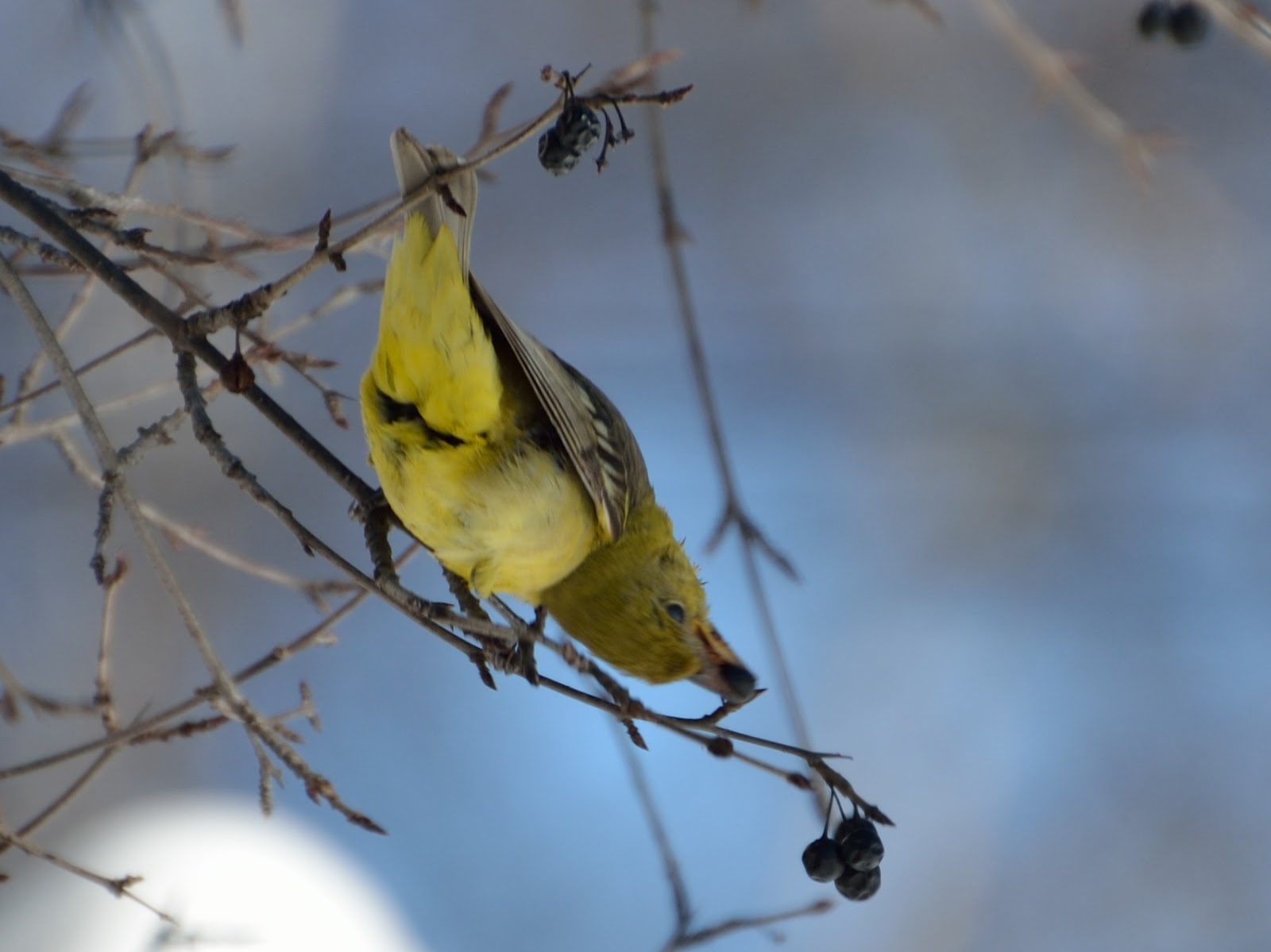
Western Tanager and Barred Owl
The long staying Western Tanager in Oshawa was a bird that I just had to go and see. Not only would it be a new Ontario bird for me, but it seemed like a fairly reliable bird to go and "twitch" since it was being seen daily. My only issue was that I didn't really want to drive all the way to Oshawa just for the tanager and a few other good birds. Luckily, an old teaching friend from Taiwan was in Toronto for the day, invited me up for a visit, and presto, more than enough reason to go and see the tanager. In reality, the tanager was enough reason to go and I would have went anyway sooner or later. I got killer looks at the tanager after waiting only about 5 minutes. Tick. It fed heavily on the buckthorn berries almost the entire time I watched it.
A Barred Owl at Hall's Rd in Whitby was also a very cooperative photo subject. Also, the two Harlequin Ducks off Whitby were still present at the mouth of Lynde Creek (distant).
Saturday, 22 December 2012
Experience Nature blog
Another Ontario birder has started a birding blog - this one by my friend and fellow Guelph Gryphon Jenn Sinasac. This blog is distinctly tropical with posts from her recent adventures in Honduras and Ecuador. While it's fun to see what crazy birds there are in the tropics, it also leaves the reader extremely envious and with the case of itchy feet.
Photo from: http://www.jennsinasac.blogspot.ca
Sunday, 16 December 2012
Woodhouse CBC
For people that aren't familiar with the Woodhouse CBC, it is located in Norfolk County and includes Simcoe, Townsend, Waterford and Port Dover. My area doesn't include any water so we don't really rack up species but we usually find a few goodies. Highlights for our area were Pileated Woodpecker, 80 American Pipits, and Northern Shrike.
I didn't stay for the entire wrap-up but the count usually ends up in the mid 70's to low 80's depending on the year.
Sounds like the best bird for the count was a probable Varied Thrush found near Port Dover with a flock of robins. Several people, including myself, will be looking for this bird tomorrow so I'll post to ontbirds if it's relocated.
I didn't stay for the entire wrap-up but the count usually ends up in the mid 70's to low 80's depending on the year.
Sounds like the best bird for the count was a probable Varied Thrush found near Port Dover with a flock of robins. Several people, including myself, will be looking for this bird tomorrow so I'll post to ontbirds if it's relocated.
Saturday, 15 December 2012
Long Point CBC results
I'll keep this brief as I'm exhausted and have another count to do tomorrow. Preliminary results from the Long Point CBC are in.
Some highlights (my point of view of course since some are common on other counts) and I'll no doubt forget some. I won't include numbers since I don't know totals for some. Many are just singles. No particular order:
Horned Grebe
Greater White-fronted Goose
Cackling Goose
Turkey Vulture
Golden Eagle
Black-legged Kittiwake
Double-crested Cormorant
Snowy Owl
Brewer's Blackbird
Eastern Phoebe
American Woodcock
Wood Duck
Trumpeter Swan
Killdeer
Common Yellowthroat
All finches but Pine Grosbeak and Hoary Redpoll
No megas or crazy warblers. No sign of my Cape May Warbler since Wednesday despite multiple people looking.
Species Total: 112
Some highlights (my point of view of course since some are common on other counts) and I'll no doubt forget some. I won't include numbers since I don't know totals for some. Many are just singles. No particular order:
Horned Grebe
Greater White-fronted Goose
Cackling Goose
Turkey Vulture
Golden Eagle
Black-legged Kittiwake
Double-crested Cormorant
Snowy Owl
Brewer's Blackbird
Eastern Phoebe
American Woodcock
Wood Duck
Trumpeter Swan
Killdeer
Common Yellowthroat
All finches but Pine Grosbeak and Hoary Redpoll
No megas or crazy warblers. No sign of my Cape May Warbler since Wednesday despite multiple people looking.
Species Total: 112
Saturday, 8 December 2012
E. Wood-pewee and Wood Thrush - listed by COSEWIC
I haven't made any posts in a while so I thought I'd do a quick PSA for those of you that don't follow changes to Canada's endangered species list made by COSEWIC (Committee on the Status of Endangered Wildlife in Canada). The addition of Wood Thrush and Eastern Wood-pewee are probably of most interest to people reading this blog, but I've also included any changes to species applicable to Ontario. Please go to www.cosewic.gc.ca for more information.
BIRDS
Wood Thrush - Threatened
From COSEWIC:
In Canada, this forest-nesting species has shown significant long and short-term declines in population abundance. The species is threatened by habitat loss on its wintering grounds and habitat fragmentation and degradation on its breeding grounds. It also suffers from high rates of nest predation and cowbird parasitism associated with habitat fragmentation on the breeding grounds.
Eastern Wood-pewee - Special Concern
From COSEWIC:
Reason for Designation: This species is one of the most common and widespread songbirds associated with North America’s eastern forests. While the species is apparently resilient to many kinds of habitat changes, like most other long-distance migrants that specialize on a diet of flying insects, it has experienced persistent declines over the past 40 years both in Canada and the United States. The 10-year rate of decline (25%) comes close to satisfying the criteria for Threatened. The causes of the decline are not understood, but might be linked to habitat loss or degradation on its wintering grounds in South America or changes in availability of insect prey. If the population declines continue to persist, the species may become Threatened in the foreseeable future.
REPTILES
Massassauga got split into two different populations with the Carolinian population being listed as Endangered and the Great Lakes / St. Lawrence population being listed as Threatened.
Eastern Musk Turtle got downgraded from Threatened to Special Concern.
Northern Map Turtle and Eastern Ribbonsnake got reviewed and remained unchanged at Special Concern.
AMPHIBIANS
Eastern Tiger Salamander got listed as Extirpated.
MAMMALS
American Badger got split into two populations with the jacksoni subspecies (southern Ontario) getting listed as Endangered and the taxus subspecies found in the prairies being Special Concern.
ARTHROPODS
Riverine Clubtail: Endangered (Great Lakes Plains population)
Mottled Duskywing: Endangered (Great Lakes Plains population)
WASCULAR PLANTS
Crooked-stem Aster - downgraded from Threatened to Special Concern
Posts without photos are boring, so here is a delicious bluebird cookie that I got to devour as I wrote this. Today was the CBC for kids down at Bird Studies Canada and a parent of some of the participants brought a whole box of these! They were delicious! Oh, and the birding today was lots of fun. A couple highlights for our group were Double-crested Cormorant, Horned Grebe, and Northern Goshawk.
BIRDS
Wood Thrush - Threatened
From COSEWIC:
In Canada, this forest-nesting species has shown significant long and short-term declines in population abundance. The species is threatened by habitat loss on its wintering grounds and habitat fragmentation and degradation on its breeding grounds. It also suffers from high rates of nest predation and cowbird parasitism associated with habitat fragmentation on the breeding grounds.
Eastern Wood-pewee - Special Concern
From COSEWIC:
Reason for Designation: This species is one of the most common and widespread songbirds associated with North America’s eastern forests. While the species is apparently resilient to many kinds of habitat changes, like most other long-distance migrants that specialize on a diet of flying insects, it has experienced persistent declines over the past 40 years both in Canada and the United States. The 10-year rate of decline (25%) comes close to satisfying the criteria for Threatened. The causes of the decline are not understood, but might be linked to habitat loss or degradation on its wintering grounds in South America or changes in availability of insect prey. If the population declines continue to persist, the species may become Threatened in the foreseeable future.
REPTILES
Massassauga got split into two different populations with the Carolinian population being listed as Endangered and the Great Lakes / St. Lawrence population being listed as Threatened.
Eastern Musk Turtle got downgraded from Threatened to Special Concern.
Northern Map Turtle and Eastern Ribbonsnake got reviewed and remained unchanged at Special Concern.
AMPHIBIANS
Eastern Tiger Salamander got listed as Extirpated.
MAMMALS
American Badger got split into two populations with the jacksoni subspecies (southern Ontario) getting listed as Endangered and the taxus subspecies found in the prairies being Special Concern.
ARTHROPODS
Riverine Clubtail: Endangered (Great Lakes Plains population)
Mottled Duskywing: Endangered (Great Lakes Plains population)
WASCULAR PLANTS
Crooked-stem Aster - downgraded from Threatened to Special Concern
Posts without photos are boring, so here is a delicious bluebird cookie that I got to devour as I wrote this. Today was the CBC for kids down at Bird Studies Canada and a parent of some of the participants brought a whole box of these! They were delicious! Oh, and the birding today was lots of fun. A couple highlights for our group were Double-crested Cormorant, Horned Grebe, and Northern Goshawk.
Monday, 12 November 2012
Tip of Long Point during Sandy
I ventured out to the Tip of Long Point on October 27th to observe birds and help out with banding duties out there - but mainly to look for rarities during superstorm Sandy. Bad weather kept me out there longer than planned but I'm not complaining about that! I made it back to the mainland on November 8th. While we didn't get any mega-rarities we still had many good birds and I was happy to have spent the time out there. Much of my birding time was spent scanning the lake from the Tip, sometimes spending 8 hours a day within a very small area. It was wet at times, windy and cold, but it's what you gotta do. Thankfully, there's a small shelter out there referred to as "The Shanty". Without it, long periods of birding would be close to impossible at such an exposed location.
Highlights were Jaegers, Little Gulls, and two Black-legged Kittiwakes. It was tough to pick out rare gulls when we had almost 10,000 Bonaparte's Gulls, and 1200+ Common Terns during Sandy.
Over 200 Brant, 17 Snow Geese, numerous Long-tailed Ducks and all three Scoter species were waterfowl highlights.
Purple Sandpiper was the best shorebird, Cave Swallows were seen several times, and flocks of Evening Grosbeaks were a nice treat.
My first Bohemian Waxwing for Long Point I found on November 3rd with a group of Cedar Waxwings.
The banders were extremely busy banding flocks of Chickadees, Siskins, and all sorts of migrants. Owl banding at night was great with hundreds of Saw-whet's getting banded and several Long-eared Owls. The Boreal Owl got banded the night I left!
To read about all the birds we saw check out the Long Point Bird Observatory Sightings board:
http://www.bsc-eoc.org/longpoint/index.jsp?targetpg=lpbosight
The Shanty provides great shelter from rain and wind (Max. occupancy 2-3)
View from the Shanty
Highlights were Jaegers, Little Gulls, and two Black-legged Kittiwakes. It was tough to pick out rare gulls when we had almost 10,000 Bonaparte's Gulls, and 1200+ Common Terns during Sandy.
Over 200 Brant, 17 Snow Geese, numerous Long-tailed Ducks and all three Scoter species were waterfowl highlights.
Purple Sandpiper was the best shorebird, Cave Swallows were seen several times, and flocks of Evening Grosbeaks were a nice treat.
My first Bohemian Waxwing for Long Point I found on November 3rd with a group of Cedar Waxwings.
The banders were extremely busy banding flocks of Chickadees, Siskins, and all sorts of migrants. Owl banding at night was great with hundreds of Saw-whet's getting banded and several Long-eared Owls. The Boreal Owl got banded the night I left!
To read about all the birds we saw check out the Long Point Bird Observatory Sightings board:
http://www.bsc-eoc.org/longpoint/index.jsp?targetpg=lpbosight
These 2 Peregrine Falcons made a brief visit to the tip. Several thousand raptors moved through the Tip following Sandy.
I watched several Merlin's snag passerines that ventured to far from cover. This one is munching a kinglet.
One of the Cave Swallows got banded giving us a chance to study it a bit closer.
Evening Grosbeaks look bad-ass and give a good bite from what I hear.
Flock of waxwings - that's a Bohemian at the top of the tree. You will have to take my word for it, although you can see that it is a bit larger.
Below are some photos of a few Horned Larks. The one individual looked really buffy on the throat and lores so I snagged a few photos of it. I know there are many subspecies, some more identifiable than others. Any thoughts on this guy/gal? Is it perhaps just a younger bird?
Subscribe to:
Posts (Atom)